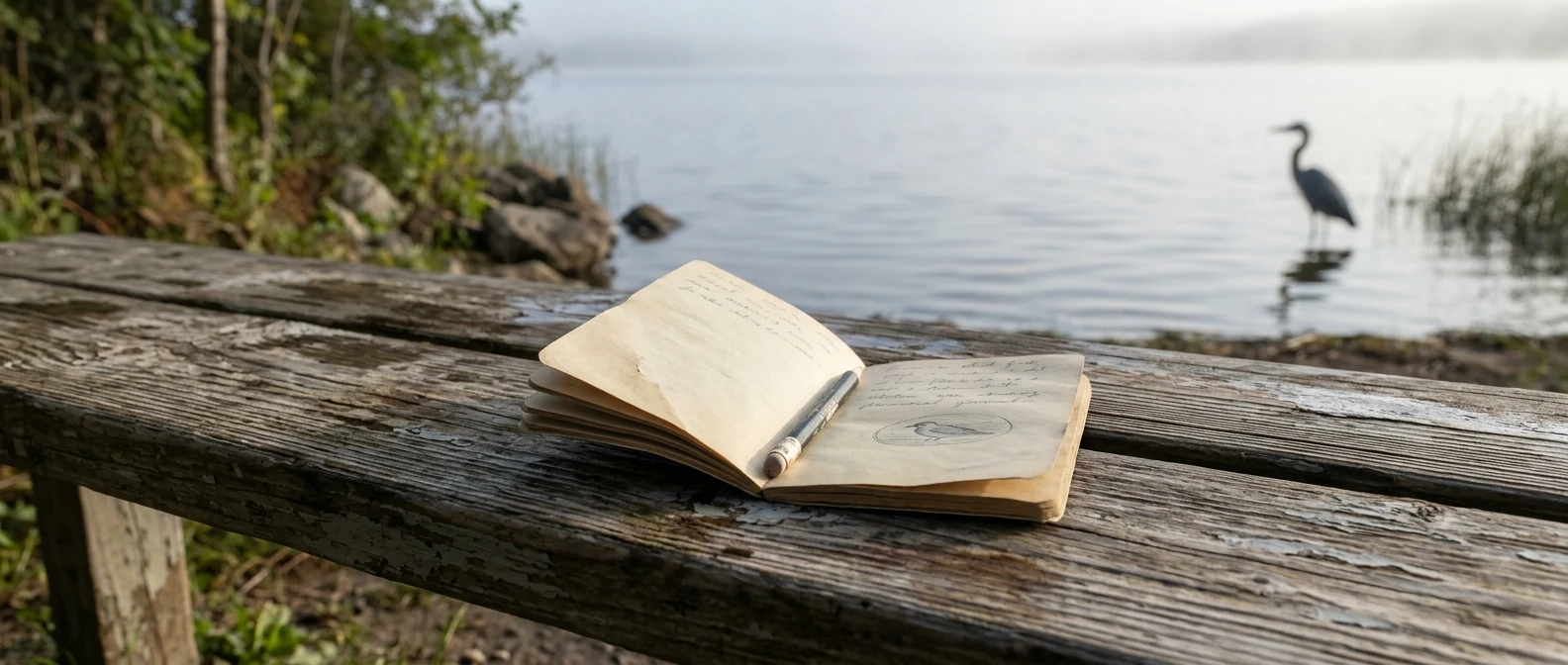
To start nature journaling, you need one pencil or pen, one small notebook, and ten minutes in a place you like. You don’t need to draw well, and you don’t need a plan for what the page should look like. A journal page records what you noticed, and words, lists, and rough shapes all count.
Bella Vista makes a good place to try it. Between the lakes, the wooded edges and the birds that show up on the water, almost any walk has something worth writing down.
Why a notebook makes you see more than a camera does
A camera captures a scene in a second, and then you move on. Writing or sketching keeps you in front of the subject long enough to notice details you would have walked past: which way the heron’s neck is bent, how the ripples spread from a single point, the color of the water where the shade meets the sun.
There is a practical reason for this. To put something on paper, even in words, you have to decide what you are looking at. That decision makes you look again. A photo of a bird on a branch is easy to take and easy to forget. A line in your notebook that says “gray bird, long legs, standing very still, didn’t move for four minutes” tends to stay with you.
None of this means you should leave your phone at home. Take the photo if you want it. Then spend a few minutes with the notebook too, and the two will give you different things.
What you actually need
The list is short:
- A pocket-sized notebook. Any small one works. Plain paper is easier than lined paper if you think you might sketch, but lined is fine. Heres a link to a small notebook on Amazon. It is a Pocket Journal, A6 3.7; the set includes 3 small notebooks and 3 black pens.x 5.7.
- A pencil. A regular pencil with an eraser is forgiving, and it won’t smear if the page gets damp.
- Something to sit on, if you like. A folded jacket does the job.
Fancy sketchbooks and watercolor sets can wait. A pricey notebook makes some people nervous about “ruining” a page, and a cheap one removes that worry. You can upgrade later if the habit sticks.
It helps to keep the notebook and pencil in the same bag or jacket pocket you always take outside, so grabbing them takes no thought.
Pick your sit spot
A sit spot is a place where you plant yourself and stay put. Standing still lets the area settle around you, and birds and other animals tend to come back into view once you stop moving.
For a first page, choose somewhere easy to reach and comfortable to sit. A few ideas in and around Bella Vista:
- Lake Norwood. Water draws wildlife, and a bench or a flat spot near the shore gives you plenty to watch. If you want a preview of the area, the Lake Norwood page covers what makes it worth the visit.
- Any lakeshore or pond in town. Pick whichever is closest to your house. The best sit spot is the one you will actually visit again.
- Your own yard or a neighborhood green space. A back step or park bench counts. Feeder birds and backyard trees give you plenty to record.
- The edge of a trail. Walk until something catches your eye, then stop and sit instead of pushing on to the end.
Pick one spot and return to it. Going back to the same place lets you see what changes from week to week, which is a big part of the fun.
The ten-minute first page
Set a timer for ten minutes if that helps you relax into it. Here is a simple order to follow: look, list, sketch, wonder.
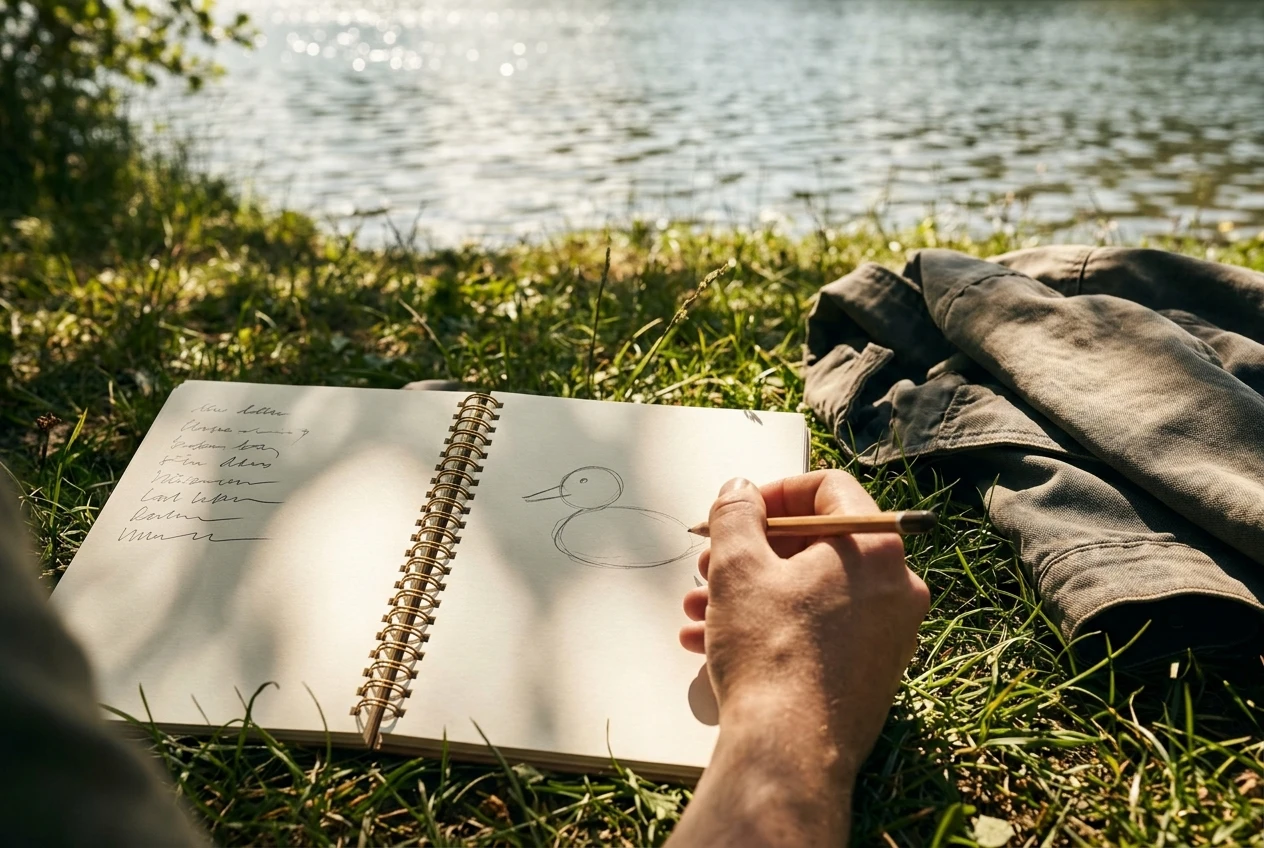
Look (two minutes)
Sit down and put the notebook away for now. Just watch. Notice what is moving, what is still, what you can hear, and what the air feels like on your face.
List (three minutes)
Open the notebook and write the date, the place, and the time at the top. Under that, write a list of everything you can see, hear, or smell. Short phrases are enough:
- two ducks near the far bank
- wind in the tops of the trees
- a woodpecker knocking somewhere behind me
- smell of wet leaves
Sketch (three minutes)
Pick one thing from your list and draw its basic shape. A bird can be an oval with a smaller oval for a head and a line for a beak. A tree can be a vertical line with a blob on top. Label what you drew. The next section covers what to do if this step feels uncomfortable.
Wonder (two minutes)
Finish with a couple of questions you can’t answer yet. “Why does the heron stand so far from the others?” or “What is that bird with the white belly?” Questions give you a reason to look something up later, or to come back and watch again.
That is a complete page. You can stop there.
Can’t draw? Words, shapes, and labels that still count
Many people stall at the sketch step because they say they can’t draw. A nature journal is a working record, and plenty of useful pages have almost no artwork. These all count as a real entry:
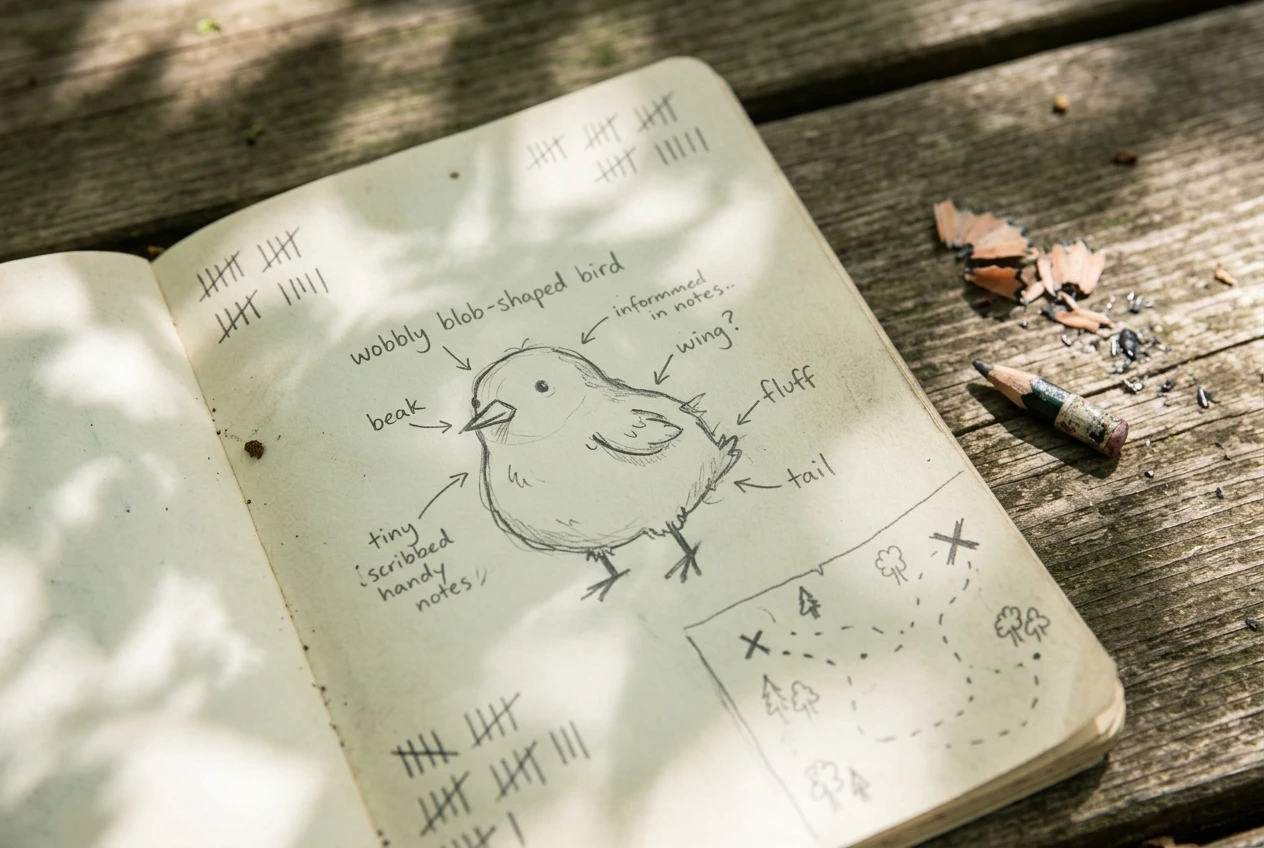
- Shapes instead of pictures. Circles, ovals, triangles, and lines are enough to show the outline of a bird, a leaf, or a hillside.
- Labels with arrows. Draw a rough blob, then point to parts and write what you saw: “rust-colored patch here,” “long thin legs,” “tail much longer than body.”
- Color notes. Write “olive green, a little yellow at the edges” next to a shape instead of coloring it in.
- Maps. Sketch a simple layout of your spot with an X where you sat and notes about where things happened.
- Words only. Write a few sentences describing what you watched, the way you would tell a friend.
- Tallies. Count how many of something passed by, such as geese, dragonflies, or people on the path.
A wobbly drawing of a bird you watched closely is more useful than a neat drawing copied from memory. The point is the looking. If you want a gentle companion for the identification side, bird watching for beginners works well alongside a notebook, and you don’t need any gear for either.
Prompts for when your mind goes blank
Some days you will sit down and feel like there is nothing to write. A prompt gives your attention a place to start. Keep a few in the back of the notebook:
- Find five different greens and describe each one.
- Write down three sounds, and where each one is coming from.
- Choose one bird and note what it does for the full two minutes you watch it.
- Describe the surface of the water right now.
- What is the smallest living thing you can find?
- Draw the shape of the clouds, or the gap between two trees.
- Write one sentence about how the place feels, then one about how you feel.
- List everything that is the same color as your shirt.
If none of those work, copy the date, place, and weather at the top and write “nothing much happening.” Something usually turns up by the end of the line.
Make it a habit
Once the first page is done, the hard part is returning. A few things make it easier:
- Pick a weekly slot. One sit-spot visit a week is enough. Attach it to something you already do, like Saturday morning coffee or an evening walk after dinner.
- Keep the same spot for a while. Repeat visits let you compare. You will start to see which birds are regulars, how the light moves, and when the leaves begin to turn.
- Follow the seasons. Autumn color, winter bare branches, spring arrivals, and summer heat all look different from the same bench. A page from each season records the year in one place.
- Date everything. The date, place, and weather at the top of each page matter more than you would think once you have a few months of entries.
- Keep your pages. Don’t tear out the ones you dislike. Early pages look rough, and flipping back to them later shows how much your eye has improved.
If a week gets away from you, skip it and sit down the next time you can. The notebook doesn’t keep score.
Turn a favorite page into something for your wall
After a few months you will have a page you like, perhaps a sketch of a bird that came out well or a list that reads almost like a poem. A few ways to display it:
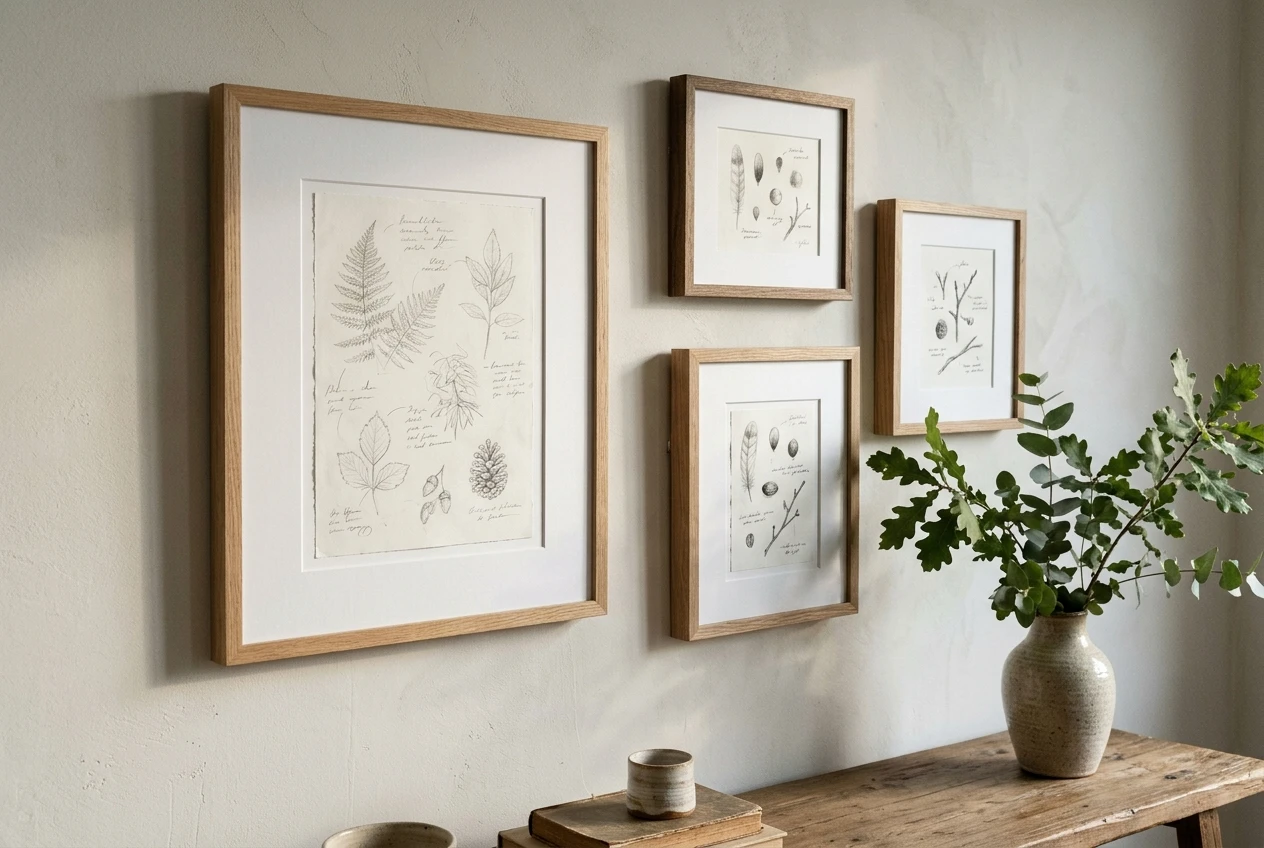
- Frame the page itself. Take it out of the notebook if you want, or photograph it first and keep the original. A plain frame and a white mat suit a pencil page.
- Use a favorite moment as a subject. Sometimes the page reminds you of a scene worth capturing in a photograph or artwork, a misty morning or a bird on the water, and that scene can become a print.
- Group several pages. Three or four small pages from the same sit spot, hung together, show how the place changes across seasons.
If you would rather have your favorite local scene on a shelf than a wall, the Lake Norwood Autumn Coasters post shows one way to bring Bella Vista home.
Try your first page this week
Grab a pencil and a small notebook, pick a spot, and give it ten minutes. Then come back and leave a comment telling me one thing you noticed on your first journal page and where in town you sat. Seeing where other readers choose to sit may give someone else an idea for their own spot.
If you want to see how one quiet moment on the water turned into a finished print, read the Morning Watch post.
Affiliate Links
This post contains an affiliate link; if you click it and purchase an item, I receive a small commission. – Shirley