There are moments on Bella Vista’s lakes that never quite leave you. Not because they’re dramatic. Not because they’re rare. But because they’re wonderfully quiet. One such moment happened while I was kayaking on beautiful Lake Ann. I’ve kayaked all seven lakes in Bella Vista, and I think Lake Ann is the most beautiful.
The water was calm; the only sounds were my paddle dipping gently into the lake and birds calling from the shoreline. As I drifted along one of Lake Ann’s peaceful coves, I noticed a Great Blue Heron walking slowly along the bank. Unlike the herons we often see standing motionless in the water, this one was quietly making its way along the shoreline, completely unaware—or perhaps simply unconcerned—that I was watching.
I lifted my camera and captured the moment. t became one of those photographs that stayed with me long after I returned home.
A Photograph Becomes Something More
Recently I’ve begun exploring a new artistic direction. Instead of simply displaying my photographs, I’ve started transforming some of my favorite images into painterly fine art.

Not to replace the photograph… but to express the feeling I experienced when I was there.
The camera records what our eyes see. Art allows us to express what our hearts remember.
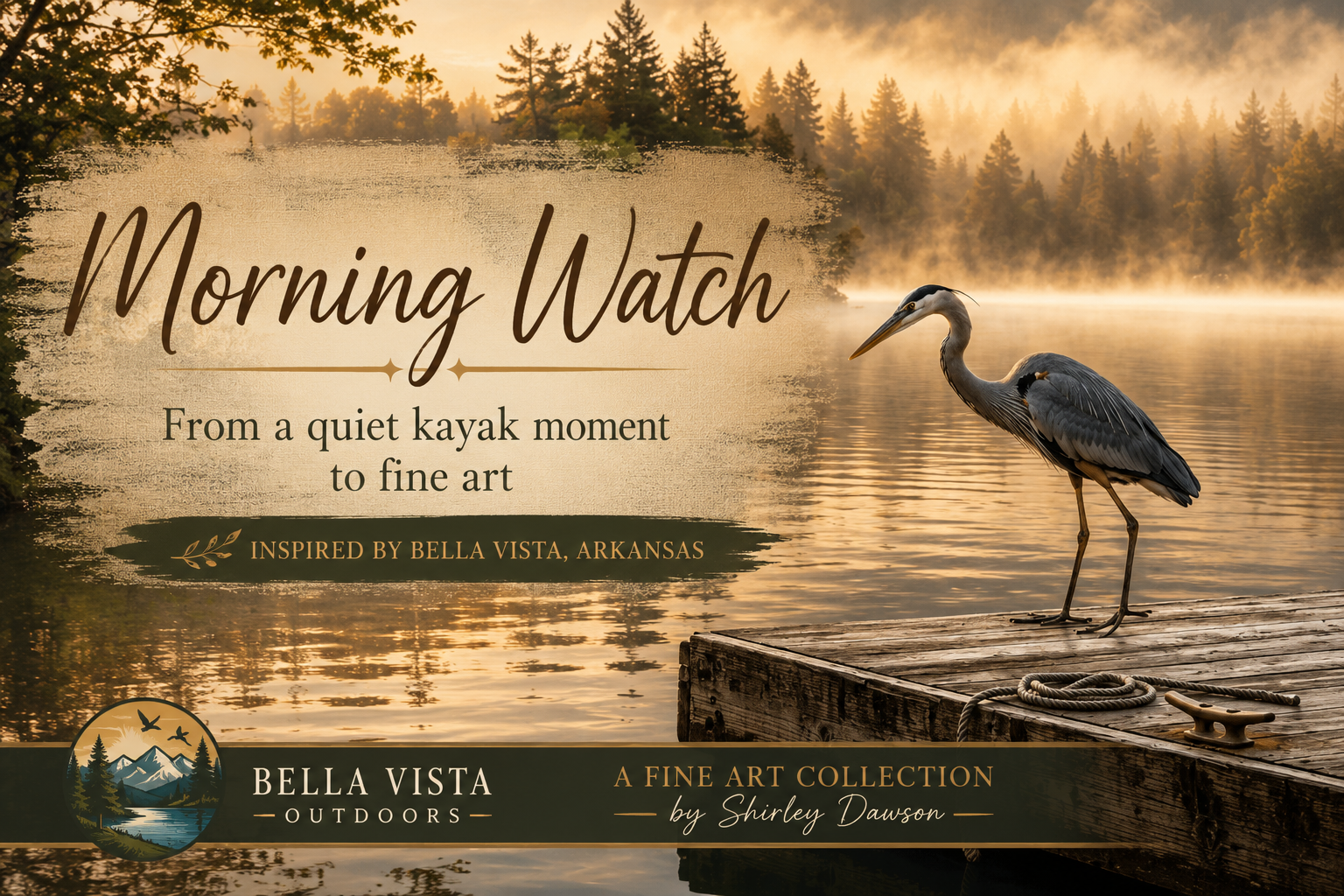
For Morning Watch, I imagined the heron greeting the first light of day from an old lakeside dock as morning mist drifted quietly across the water.
The finished artwork isn’t meant to be an exact recreation of that morning on Lake Ann. Instead, it captures the peaceful feeling that remained with me.
Why the Title “Morning Watch”?
As I looked at the finished art image, it felt as though the heron had arrived before everyone else.
- Before the fishermen.
- Before the kayakers.
- Before the world had fully awakened.
- Patiently watching.
- Waiting.
- Completely at home.
The title “Morning Watch” seemed to fit perfectly.
About the Artwork
The finished piece is part of my new Fine Art Collection by Shirley Dawson, a series inspired by my own original photographs and reimagined as painterly works of art on canvas
Each piece begins with a real place I’ve visited and a real moment I’ve experienced.
From there, imagination, memory, and artistic interpretation work together to create something that tells a deeper story than the original photograph alone.
Bringing Morning Watch Home
Whether displayed in a lake house, cabin, office, or your favorite reading corner, I hope Morning Watch offers the same sense of peace I experienced that morning on Lake Ann.
Sometimes the most meaningful moments aren’t the loudest ones.
They’re the quiet ones that ask us to slow down, breathe deeply, and simply notice the beauty around us.
Morning Watch Fine Art Canvas
Imagine this Art Canvas hanging on your wall.

You can see this Fine Art Canvas and other Products in my Bella Vista Outdoors Shop.
Behind the Art
My original photo was taken as I was kayaking in Lake Ann. I enhanced the image, visualizing it as a lovely art piece on a lake, sitting on a dock in morning light with fog over the lake. I created the prompt and worked with my AI tools to create a beautiful fine art piece. I upsized that image so it could be printed and added it to my Bella Vista Outdoors Shop as a gallery-wrapped canvas.
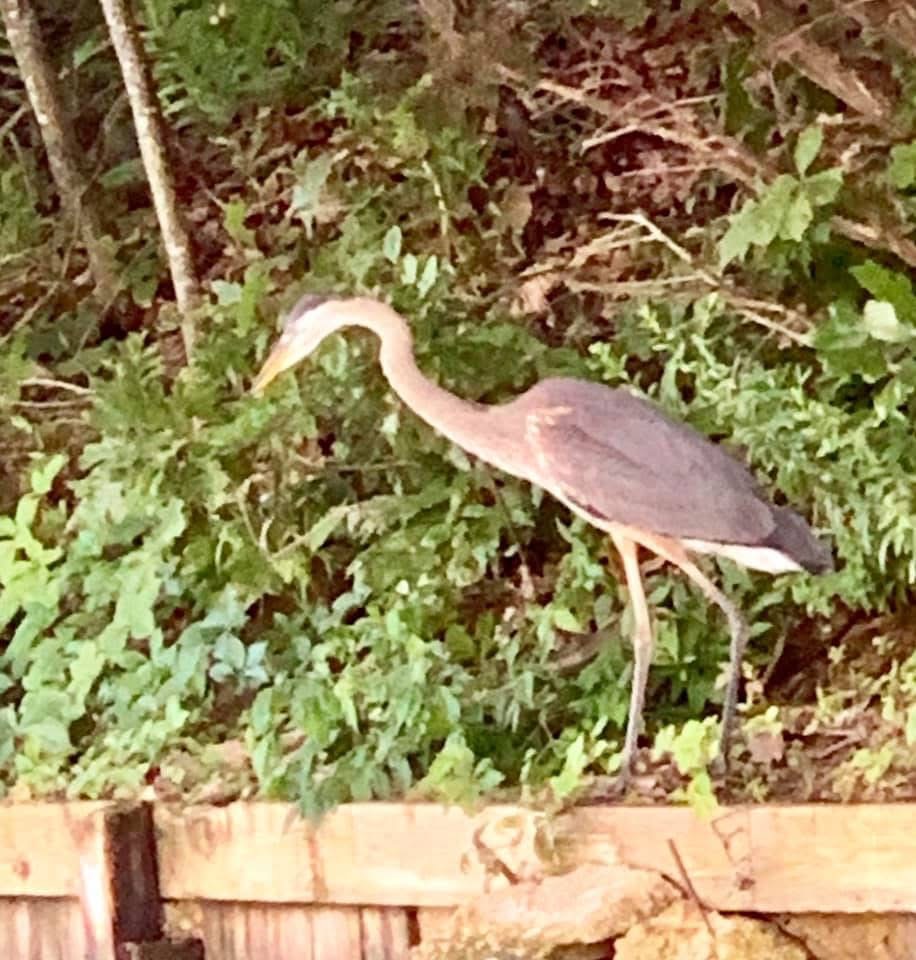
The final art image turned out beautiful
A New Chapter for Bella Vista Outdoors
If you’ve followed Bella Vista Outdoors for a while, you’ve seen me share photographs of birds, lakes, trails, and changing seasons around our community.
This new Fine Art Collection is a natural extension of that journey.
Each artwork begins with one of my own photographs and is thoughtfully reimagined as painterly fine art, blending photography, memory, and imagination to tell a story beyond the original image.
I hope you’ll enjoy following this collection as it grows—one quiet place, one memorable moment, and one painting at a time.
I enjoy receiving comments and questions from site visitors; you can leave yours below. – Shirley
Shirley, I really enjoyed reading this. I think many of us have experienced those quiet moments in nature that stay with us long after we’ve gone home, even if nothing dramatic happened. Your description of paddling across the calm water and spotting the heron made me feel like I was there with you.
What I found especially interesting was your explanation of turning a photograph into a piece of fine art. I like the way you described it—not as replacing the photograph, but as expressing the feeling of the moment. That’s a distinction I hadn’t really thought about before, and it gives me a new appreciation for this kind of artwork. The finished canvas has a peaceful, almost timeless quality that invites you to pause and look at it for a while.
I’m curious as your collection grows: do you usually know which photographs will translate well into fine art when you take them, or do some images surprise you later when you revisit them and realize they have a story waiting to be told?
– Scott
Scott thank you for reading my post and your very nice comments. To answer your question. Most of the photos I’m using for my new find art creations are ones taken years agi when I could still walk and get in a kayak. I can’t do that anymore. But I can use my iPhone and my desktop computer and my software like photoshop and I’ve been learning to use AIs. I took.lots of photos in those days and saved lots of digital images. I’ve always tried to capture images of nature and beautiful things and places. I’ve been going through hundreds of saved photos and picking out ones I feel have qualities that can inspire fine art. Many I remember taking and how I felt when snapping that shutter. I also use photos taken by my photographer friend Dave Melear with his permission. Thanks again -Shirley
I found it interesting that the heron was originally walking along the shoreline, but in the finished artwork you imagined it standing on an old dock with mist drifting over the lake. That change feels very natural and still seems faithful to the peaceful mood of the original moment. I often think memories work in a similar way, we may forget some exact details, but the feeling remains very clear. When you transform a photograph this way, how do you decide which parts of the real scene must stay unchanged and which elements you can freely add or move without losing the personal memory behind it?
Hanna, thanks for reading my post and your comments. To answer your question about which parts to leave or change, I often have conversations with ChatGPT, discussing potential ways to create a mood, and usually, after discussing the story behind the original photo and how I remember feeling, we decide which scene to create. The AI may give several suggestions, and I pick the one I like best, and we decide where to go from there. The AI will create a prompt to use; I edit it to add things I’d like to change, and then I use that prompt within kre8or.ai to create a first image. I usually then share a screen capture of the resulting image with ChatGPT and ask for it to critique it. It will often come back with additional suggestions or ask additional questions. We then decide what needs to be changed in the “remix,” and this usually results in a completed fine art image I can use. For my purpose (creating a Fine Art Gallery Wrapped Canvas product for my POD (print on demand) store, I upsize the image to meet print resolution requirements, then upload to Printify (my POD store is through Printify), create the title, the description, decide on price, and publish to my Shop. I usually then use Kre8or to create mockup images to use with the Shop listing to show the gallery-wrapped canvas in a real-life setting. That’s my process. Thank you again. – Shirley