
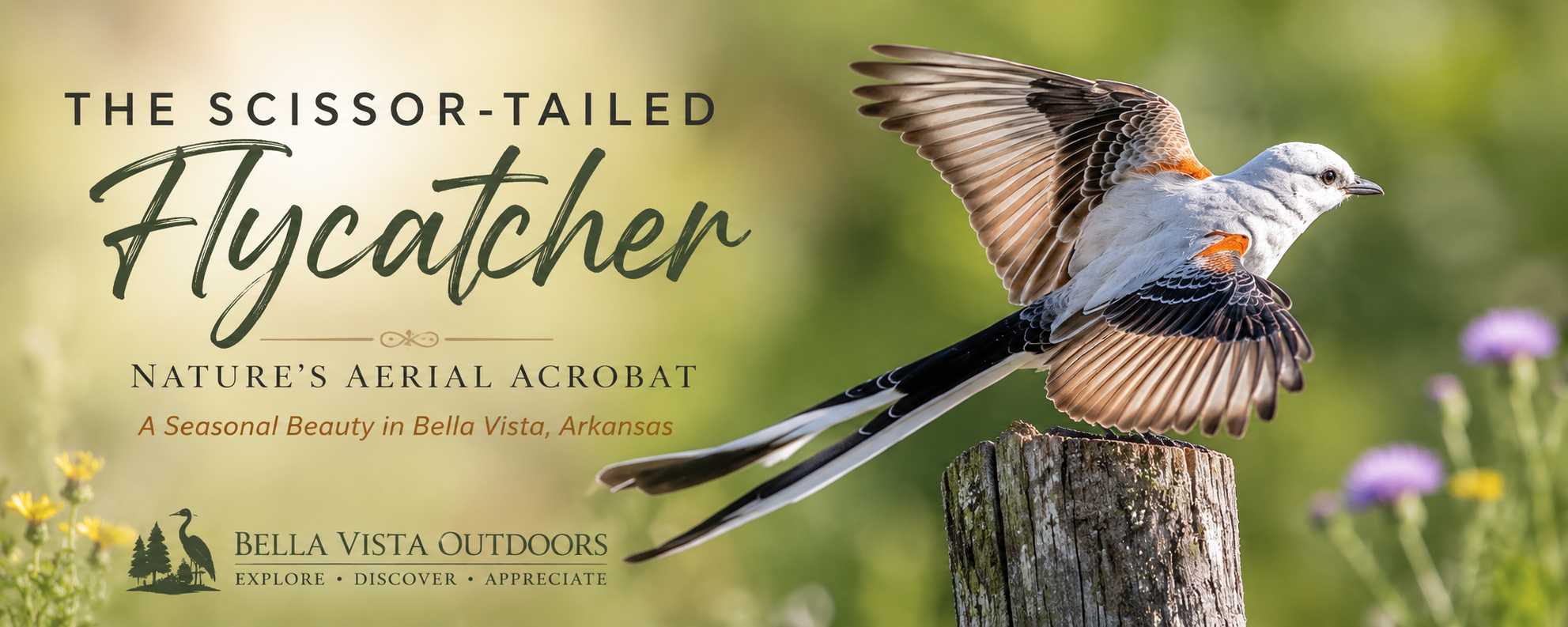
Known as a Tyrant Flycatcher
There are few birds as graceful or instantly recognizable as the Scissor-tailed Flycatcher. With its incredibly long forked tail, soft gray plumage, salmon-colored patches beneath its wings, and effortless flight, this remarkable bird often stops birdwatchers in their tracks.
Although it is the state bird of Oklahoma, the Scissor-tailed Flycatcher is also a welcome sight throughout Northwest Arkansas, including Bella Vista during the warmer months.
Whether perched on a fence post or launching into the air after an unsuspecting insect, this elegant bird always seems to put on a show.
Built for Life on the Wing
Scissor-tailed Flycatchers belong to a group of birds known as tyrant flycatchers, specialists in catching insects while flying.
Rather than searching for food on the ground, they often perch in an open location where they patiently watch for flying insects. Once they spot their target, they spring into the air with remarkable speed, snatch the insect, and often return to the very same perch.
This hunting style is known as hawking, and watching one in action is one of the joys of spring and summer birding.
That Incredible Tail
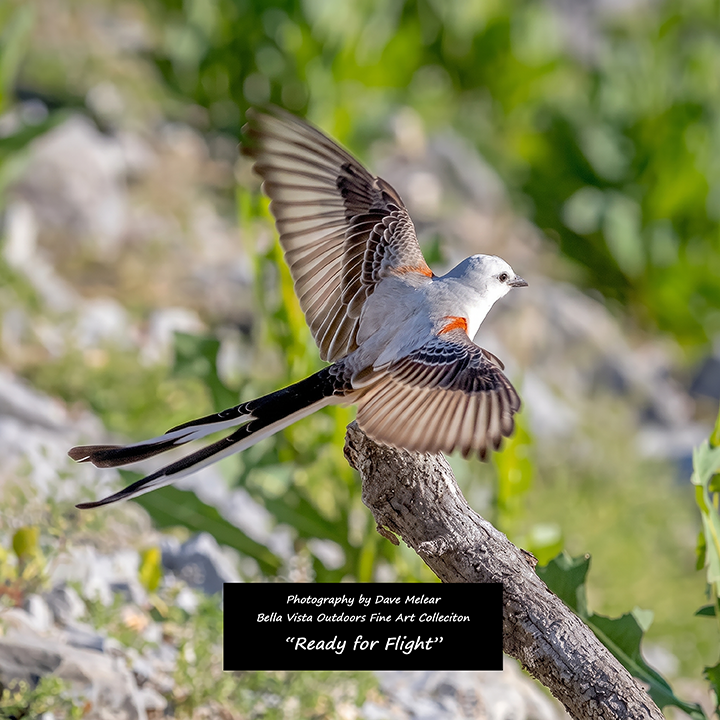
The bird’s signature feature is, of course, its spectacular tail.
Adult males have the longest tails, sometimes measuring nearly twice the length of their bodies. While the tail certainly adds beauty, it also serves practical purposes by helping with balance, steering, and the sharp aerial turns required to catch insects in flight.
During courtship, males perform dramatic flight displays, showing off those graceful tail feathers to attract a mate.
A Seasonal Visitor
Scissor-tailed Flycatchers spend the winter in Mexico and Central America before returning north each spring to breed.
In Bella Vista and throughout the Ozarks, they are most often seen from late spring through summer, favoring open fields, roadsides, parks, golf courses, and utility lines where they have unobstructed views of flying insects.
Their cheerful calls and elegant flight make them one of the most enjoyable birds to watch during the warmer months.
A Photographer’s Reward
Wildlife photography often requires patience, persistence, and a bit of luck.
Capturing a Scissor-tailed Flycatcher with its wings fully extended is a fleeting moment that may last only a fraction of a second. Photographer Dave Melear has spent countless hours observing wildlife throughout the Ozarks, waiting for just the right combination of light, position, and timing.
The photograph featured here, titled “Ready for Flight,” captures that split second before the bird launches into the air—a moment that perfectly showcases the elegance that makes this species so beloved by bird enthusiasts.
Bringing Nature Home
This canvas is the first release in our Bella Vista Outdoors Fine Art Collection, celebrating the wildlife and natural beauty of Northwest Arkansas. We recently added “Ready for Flight” to the Bella Vista Outdoors Fine Art Collection in the Bella Vista Outdoors Shop. If you’d like to bring this remarkable bird into your home, take a look at our Ready for Flight Fine Art Canvas Print.
Printed on premium satin canvas with black gallery-wrap sides, this artwork celebrates one of the Ozarks’ most graceful birds and is available in several square sizes for homes, cabins, offices, and nature lovers who want to bring a little piece of Bella Vista indoors.
More about the Tyrant
Did You Know?
- Oklahoma’s official state bird.
- Can catch insects in midair with incredible agility.
- Males have tails nearly twice the length of their bodies.
- Winters in Mexico and Central America before returning each spring.
Have You Seen One?
Have you spotted a Scissor-tailed Flycatcher in Bella Vista?
We’d love to hear where you’ve seen them or see your favorite photographs. Share your experiences in the comments and help us celebrate one of the most beautiful birds that visits our corner of the Ozarks.
🪶 Henry’s Nature Note: If you spot a Scissor-tailed Flycatcher sitting quietly on a fence post or utility wire, don’t assume it’s resting. It’s probably scanning the air for insects. Watch for a minute or two—you may see it launch into the air, snatch its prey with an amazing mid-air twist, and return to the very same perch.
Hi! What a fascinating article. I really enjoyed learning about the Scissor-tailed Flycatcher and the unique way you described its aerial abilities. Nature has so many remarkable creatures, and it’s always a pleasure to discover something new through articles like yours. Your photographs also add so much to the experience and really bring the bird to life. I’m curious, have you had many opportunities to observe this bird in different seasons, and does its behaviour change noticeably throughout the year? Thanks for sharing such an enjoyable read!
Bryce, thank you for reading my blog post and your comments. I agree there are a lot of cool creatures in nature and its fun learning more about them. I really love photography and capturing wildlife is part intention and part luck. To my knowledge the Scissor Tailed Flycatcher in Arkansas has certain months you can find them. Here’s some online information you can read. https://en.wikipedia.org/wiki/Scissor-tailed_flycatcher. In my area, they are seen in more open areas, so visit areas with tall grasses and open skies, such as prairies or meadows. They’re most active during the day. They winter elsewhere. Thanks again for your comments – Shirley
Hi! What a fascinating article. I really enjoyed learning about the Scissor-tailed Flycatcher and the unique way you described its aerial abilities. Nature has so many remarkable creatures, and it’s always a pleasure to discover something new through articles like yours. Your photographs also add so much to the experience and really bring the bird to life. I’m curious, have you had many opportunities to observe this bird in different seasons, and does its behaviour change noticeably throughout the year? Thanks for sharing such an enjoyable read!
Bryce, thanks for reading my article and for your kind comments. Unfortunately, I’m handicapped and mostly homebound. I do watch many Bella Vista birds at my feeders (I have 4), but the Scissor-tailed Flycatcher is not a “feeder-attracted” bird, so I rely on my photographer friends and their wonderful images to enjoy this bird commonly seen in my Ozark Mountain area. As the post indicates, this bird is seen in the spring/summer months around here. I plan to create another cool POD fine art product soon for my Shop, featuring another great image of the Scissor-tailed “Tyrant” from my photographer friend Dave Melear. Thanks again. – Shirley
I really loved your breakdown of how these birds use that incredible tail not just for show but for actual balance and steering during those sharp mid-air turns. I’ve tried photographing birds in flight before, but I always struggle with timing the shot right when they launch off the perch, and your note about them scanning quietly before striking made me realize I’ve probably been missing those split-second cues.
How would you recommend positioning yourself to get a clear shot without spooking them when they’re perched on something exposed like a utility wire? I feel like getting close enough for detail without interrupting their hunting rhythm is the hardest part, and I’m never quite sure how to read when they’re about to take off.
rapota, thank you for reading my post and your comment, I will be creating another post soon with additional info on the Scissor-tailed flycatcher. As for your questions, I admit I did not take the image in the post? A friend did, who is better photographer than I am. My camera is older and I need an upgrade. I’m thinking about the Canon R7. Here’s a link to a great article on bird photography which may help. https://digital-photography-sc…
That article has some great tips, including patience and learning about your target birds.
thanks again -Shirley